
The Duties of an Executor in Ontario
Being an executor in Ontario is like being handed the master key to someone’s life story after they’ve turned the last page. It’s not about power; it’s about promise. You’re the one who makes sure their final wishes don’t get lost in the shuffle of grief.
You’re the caretaker of their legacy, the one who turns “I hope…” into “It’s done.”
For a comprehensive document outlining executor duties, make sure to select ‘Download PDF’.
What is an Executor? (Ontario)
An executor is a legal representative named in a will to handle an estate when someone dies. Undertaking the responsibilities of an executor can be challenging and frustrating, especially after the loss of someone close to you. To make things easier, I’ve created a detailed checklist of the duties of an executor in Ontario.
Think of my checklist as a roadmap to guide you through a heartfelt responsibility—honouring your loved one’s wishes while caring for the people and details they left behind. I’ve grouped the tasks into several phases to make it feel more manageable.
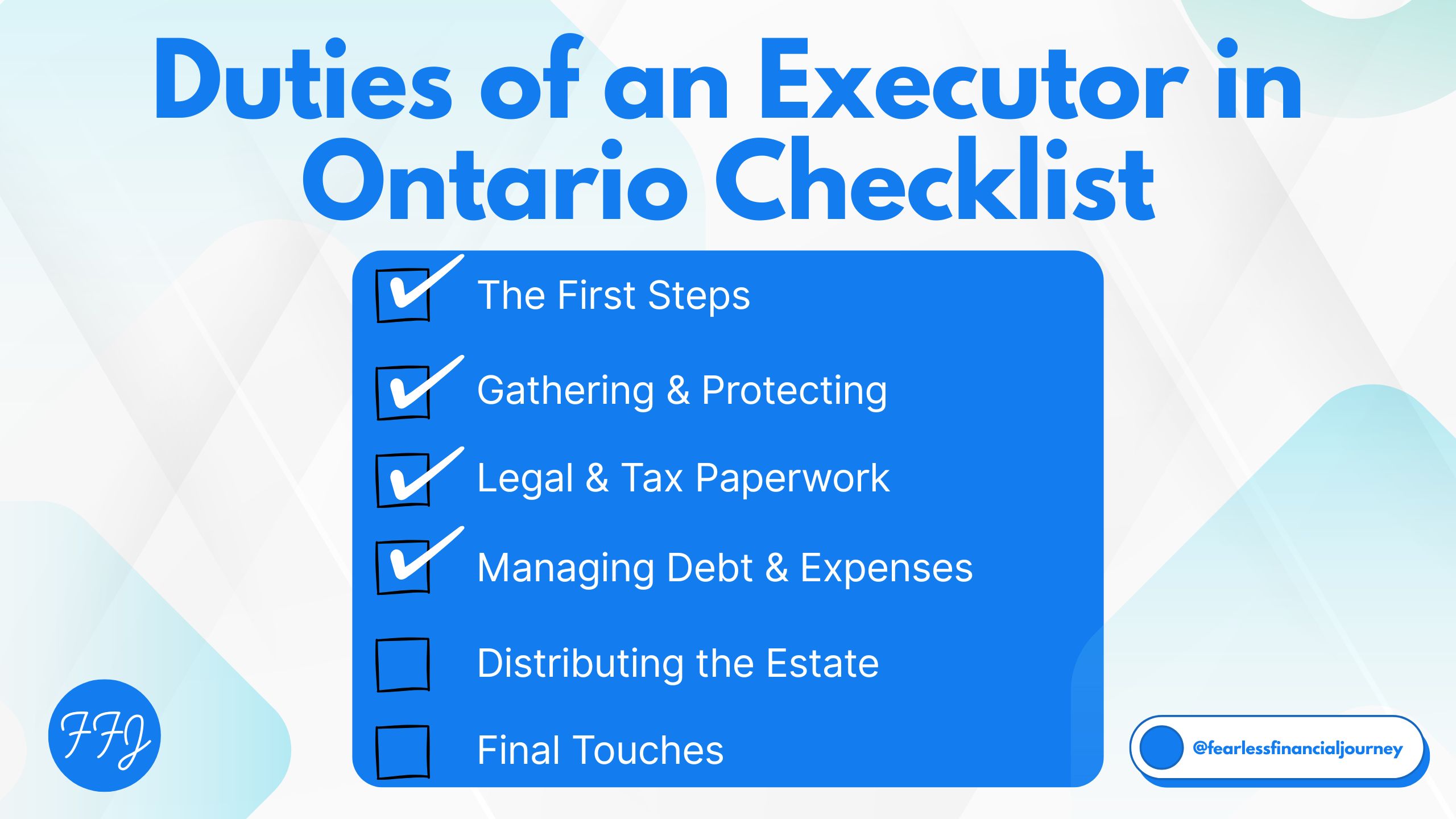
The Duties of an Executor in Ontario (Checklist)
Before dissecting the responsibilities of an executor, it’s important to understand that you are allowed to hire help. The extensive duties spanning several months to years can be taxing and overwhelming as an executor. Industry professionals specialized in estates can help you navigate the processes that make up your role as executor.
These professionals include:
- Lawyers – help with the will, beneficiary disputes, creditor disputes, and probate.
- Accountants – help with probate taxes, individual tax returns, estate tax returns, and corporate tax returns.
- Appraisers – help with valuing assets, including real estate, collectibles, and large assets.
- Friends & Family – while they may not be industry professionals, they can help with your responsibilities and provide support on a day-to-day basis.
Reasonable fees incurred from industry professionals may be paid from the estate.
Being named an executor of someone’s estate carries a large responsibility, and often brings a feeling of pressure to satisfy the wishes of the deceased and the beneficiaries.
It’s important for individuals to understand they have a choice in accepting the role as executor.
There are policies and steps designed for a named executor to relinquish the role!
The First Steps
These first steps are not just formalities—they’re essential actions that protect the estate and set everything else in motion.
- Locate the original will and keep it in a safe place. Review the will for any specific instructions regarding the funeral.
- Arrange the funeral if the family wishes you to—check the will for any pre-paid plans or specific funeral requests.
- Notify close family and friends of the death.
- Secure the home: change locks if necessary, forward mail, stop newspapers, and arrange for the care of any pets.
- Order multiple death certificates (10–15 originals, banks and agencies will each want one).
- Cancel CPP (Canada Pension Plan) and/or OAS (Old Age Security) benefits.
Before proceeding to legal or financial matters, ensure that the will is located, the home is secure, and loved ones have been notified.
Taking care of these details promptly ensures stability, respect, and a clear path forward for your future duties.
Gathering & Protecting Assets
This next stage is all about ensuring that everything the deceased owned is accounted for, protected, and organized before proceeding.
Applications & Notifications
- Apply for CPP survivor benefits (if applicable/eligible).
- Apply for the CPP Death Benefit ($2,500 lump sum) if the deceased contributed to the CPP (Canada Pension Plan).
- Notify financial institutions (such as banks, credit issuers, pension providers) and request account freezes where necessary.
- Fill out any necessary paperwork to collect any life insurance.
- Contact the employer regarding pension plans and death benefits.
Documenting, Organizing, & More
- Create a comprehensive inventory of all assets, including bank accounts, investments, real estate, vehicles, jewelry, digital assets (such as cryptocurrency wallets), and safety deposit boxes.
- Pay probate taxes to the provincial government (if probate is necessary).
- Create a complete list of all outstanding debts.
- Cancel subscriptions (cell phone, streaming services, magazines) and redirect or stop non-essential services (wi-fi, vehicle insurance).
- Open an estate bank account to receive income and pay bills—keeps everything separate and clear.
Gathering assets and documenting debts ensures nothing is lost or overlooked, while notifying institutions and opening an estate account keeps finances clear and separate.
Taking these steps early enables you to carry out your duties efficiently and responsibly.
Real estate asset lists may include far beyond what is mentioned in this article. Consulting with a qualified professional can help you identify what to look for and provide more guidance on the subject.
Legal & Tax Paperwork
This stage focuses on handling all legal and tax obligations carefully to protect both the estate and yourself as executor.
- Apply for a Certificate of Appointment of Estate Trustee (probate) if required (real estate, large bank accounts, or institutions will ask for proof).
- Advertise for creditors in: NoticeConnect Online (recommended), Local Newspaper (the traditional option), the Ontario Gazette (protects you from unknown debts).
- File the final personal tax return (T1) for the year of death—due April 30 (or June 15 if self-employed).
- File any trust (T3) returns for estate income earned after death.
- Obtain a tax clearance certificate from the CRA before final distribution—this confirms that all taxes have been paid.
Applying for probate gives you the legal authority to manage and distribute assets, which is especially important for real estate, large bank accounts, or other institutions that require proof of your role.
Advertising for creditors is a key protection step: by notifying potential creditors through online services, newspapers, or the Ontario Gazette, you create a public record giving anyone owed money a chance to come forward.
This step shields you personally, as the executor, from personal liability if a claim arises after the assets have been distributed.
Paying Debts & Expenses with Care
One of the executor’s most important duties is settling the estate’s debts and ongoing expenses correctly and in the proper order. Failing to address these obligations before distributing assets can expose an executor to personal liability. These include:
- Paying funeral costs, taxes, utilities, mortgages, credit cards, and valid creditor claims.
- Keeping meticulous receipts—transparency in your role brings peace of mind to the beneficiaries and protects you from liability.
- Rejecting invalid creditor claims politely in writing (you have protection under the Trustee Act).
It’s essential to keep meticulous records of every payment made on behalf of the estate.
Save invoices, bank statements, and receipts, and document the purpose of each expense. Clear record-keeping ensures transparency, helps answer beneficiary questions, and provides protection if your actions are ever reviewed.
Not every creditor claim presented to an estate is valid. As an executor, you are entitled to review and verify creditor claims before paying them. If a claim is incorrect, you may reject it—politely and in writing. Ontario’s Trustee Act offers legal protection when executors act honestly, reasonably, and in good faith, allowing you to carry out your role with confidence while safeguarding the estate.
Distributing the Estate
The distribution of an estate in Ontario typically doesn’t happen immediately. Executors are expected to wait until debts, taxes, and potential claims are resolved, which is why distributions often occur 12 months or more after death (commonly referred to as the “executor’s year”).
Steps when distributing the estate include:
- Obtaining a Clearance Certificate from the Canada Revenue Agency (CRA).
- Preparing clear accounting (like a family ledger) showing every dollar in and out—share this with all of the beneficiaries for complete transparency.
- Transferring specific gifts (e.g., “my grandmother’s ring to Nancy”) first.
- Selling assets only if needed (house, car, stocks)—get fair market value and keep records.
- Distributing the residue (what’s left) according to the will’s percentages or shares.
Clearance Certificate
A Clearance Certificate must be received from the Canada Revenue Agency before distributing any assets to beneficiaries. This certificate validates that all estate taxes have been paid to the Canada Revenue Agency, and you are clear as the executor to distribute.
Specific gifts named in the will should be transferred first. These are items or amounts given to particular people, such as jewelry, heirlooms, or designated cash gifts.
These gifts should only be distributed once you are confident the estate has sufficient funds to cover all remaining obligations.
Assets such as a home, vehicle, or investments should only be sold if necessary to pay debts, taxes, or to allow for fair distribution among beneficiaries. When selling assets, obtain fair market value and keep thorough records of appraisals, listings, and sale documents to demonstrate that you acted prudently and in the estate’s best interest.
Once all obligations are settled and specific gifts have been distributed, the remaining assets—known as the residue—are distributed according to the percentages or shares set out in the will.
Careful timing, documentation, and communication throughout this process help protect yourself as the executor and give beneficiaries confidence that the estate has been handled properly in a time of grief.
Final Touches
- Close the estate bank account after any outstanding matters are settled.
- File a final accounting with the court if probate was required.
- Keep records for 7 years (the CRA may ask for them in the future).
- If the will creates an ongoing trust (e.g., for minors), arrange a successor trustee.
As an executor, you’ll need to keep records of all material transactions, receipts, timelines, correspondence, and financial documents related to the estate, either as physical copies in a safe folder or binder or as digital copies.
The CRA can audit estate distributions up to 7 years in the future, which is why it’s essential that, as the executor, you maintain copies of everything.
A Reminder to You, the Executor
- You can always hire help: Lawyers, accountants, and appraisers can all help you manage the new responsibilities while you try to balance grief at the same time—reasonable fees are paid from the estate.
- Take breaks: Grief + paperwork is heavy. A walk or a cup of tea can recharge your heart.
- Communicate: Regular updates to beneficiaries prevent worry; everyone experiences the grief of losing a loved one.
You’re not just “administering an estate”—you’re honouring the final chapter of someone’s life story with dignity and love. If you ever need assistance, please reach out to an estate lawyer or a trusted advisor.
Information in this communication is not intended to provide legal, accounting, investment or tax advice, and should not be relied upon in that regard. Professional advisors should be consulted prior to acting based on the information contained in this communication. Eeva Niemi is a Financial Advisor with CI Assante Wealth Management Ltd. The opinions expressed are those of the author and not necessarily those of CI Assante Wealth Management Ltd. Please contact Eeva at eniemi@assante.com or visit https://advisor.assante.com/Eeva-Niemi to discuss your particular circumstances prior to acting on the information above. CI Assante Wealth Management Ltd. is a Member of the Canadian Investor Protection Fund and the Canadian Investment Regulatory Organization. Insurance products and services are provided through Assante Estate and Insurance Services Inc.
References:
https://www.ontario.ca/laws/statute/90t23
https://www.rbcwealthmanagement.com/en-ca/royal-trust/resource-centre/estate-settlement-executor-resources, https://dynamic.ca/content/dam/docs/marketing/brochures/snapshots/12DWD268_SN_DF_IN_ExecutorHandBook_Fillable_EN.pdf
https://www.canada.ca/en/revenue-agency/services/tax/individuals/life-events/doing-taxes-someone-died/clearance-certificate.html